AMPAC Study Session 179: Study Board The continuous Practice of general International Law and the continuity of the “Specifics” of the Empire of Morocco’s bilateral and multilateral treaties, under the Sultan and the Moorish Government, through the emergence of the de jure competent authority of “legal personality” of the Empire of Morocco as the original State, and its national inhabitants recognized as Moorish subjects, Moors, Moroccans subjects, or Moroccan Nationals. WESTERN SAHARA (SEP. OP. DE CASTRO) 149 4. Pre-Sahara Zone and Boundaries of the Kingdom of Morocco The consistent testimony of historians and geographers is that the southern limit of the Moroccan Empire was at the extremity of the pre-Sahara zone. The political status of the zone was singular. The Sultan claimed to be the sovereign, and was considered as such de jure, but not de facto in the geographical maps and by the European States. It was a strange situation: the boundaries of Morocco remained undetermined. The Moroccan authorities could not state exactly where they were, and gave only delaying answers to the Spaniards' requests for information.
The Bled Siba was in the power of local chiefs or sheikhs, either fighting or allied among themselves, so that relations with the Makhzen were always liable to change according to whether the Sultan's forces were approaching or whether he needed aid in his internal quarrels. The zone of the Souss was in that irregular condition, which was still further complicated by the fact that the almost independent principalities more or less eluded the Sultan's independent authority. The cartographers knew the coastal zone well, but had to take its variations into account. That explains why in the maps of Morocco, from the seventeenth to the nineteenth century, Morocco's frontier is placed at Cape Noun, to the south of the Noun, to the north of Cape Noun, on the Messa river, at Cape Agulon, at Cape Juby and on the Wad Dra'a, bounded by the region of the independent Moors and by the Kingdom or State of Sidi Hisham and the Wad Noun. On the subject of those principalities, we are told that "Tazeroualt corresponds to the State of Sidi Hisham; . . . [it] includes the township of Iligh and the tomb (Kouba) of Sidi Ahmad-ou-Moussa" (H. de Castries, "Notice sur la région de l'oued Draa", Bulletin de la société de géographie, 1880, Vol. XX, p. 500). The country of the Wad Noun (to the south of Tazeroualt) is also called, after the name of the founder of the dynasty, the State of Abid-Allah-Ou-Salem; the representatives thereof in 1880 were the Beyrouk brothers.
"Tazeroualt and the Wad Noun in reality never came under Morocco. However, according to the author of Roud-el-Kartas, the Almohad sovereign Abdel Moumen (1 159) extended his authority over that land." (Castries, op. cit., p. 501 .)
It is also to be noted that towards 1765 the greater part of the Tekna confederation, which was established at the mouth of the Dra'a, freed itself of Moroccan control'. The Moroccan Tekna are not to be confused with the free Tekna of the Sahara 2. The political situation of the zone is still further complicated by the fact that the chiefs of the zone extended or claimed to have authority over the zone of Tarfaya. Thus Beyrouk made agreements with Mackenzie concerning the establishment of the trading-station at Cape Juby, as an independent authority, and he also tried to urge the European Powers to build a harbour in the region, against the interests and despite the opposition of the Sultan. Nevertheless there was a time, when the differences between the Beyrouks and the Moroccans came to an end, when Beyrouk received from the Sultan an appointment as caid; but, for that very reason, Beyrouk found his authority over the Tekna tribes disappearing (Trout, Morocco's Saharan Frontiers, Geneva, 1969, p. 151).
The advance of the French armies changed everything (F. de la Chapelle, "Esquisse d'une histoire du Sahara occidental", Hespéris, XI, fascs. 1-2,1930, p. 90). But, as Miège said in his essay on Morocco, it is to the French forces that Morocco owes the pacification of the unsubjugated zones. "For the first time, the whole of the country came under the same central power. The immediate consequence was the development of a national self-awareness." (Miège, Le Maroc, Paris, 1950, p. 43.) This peculiarity of the Bled Siba affords the explanation and justification of the so-called shipwreck clause for the Souss region '. The origin may be found in the Treaty of Peace and Commerce between the Sultan of Morocco and the King of Spain of 28 May 1767. Later this became a customary clause in the Treaties between Morocco and European Powers. The fact is that the idea that sovereignty implied responsibility for unlawful acts of a sovereign's subjects was well known to Morocco. In order to affirm the concept of Morocco as sovereign in al1 regions claimed as belonging to it, Moulay Hassan decided, in order that doubt should not be thrown on his authority over those territories, to entertain the requests for indemnity submitted to him, thus exacerbating, as Miège observes, the bleeding of the Moroccan Treasury (Le Maroc et l'Europe, III, p. 357; IV, p. 417).
A further consequence of this curious situation of the Bled Siba is that the Moroccan authorities were unable to pinpoint the southern frontier of the Moroccan Empire. The repeated enquiries of European Powers as to the boundaries of Morocco received no precise reply. At best, the old aspirations to empire were invoked (Miège, op. cit., III, pp. 305-306). Sultan El-Hassan Ben Muhammad was to reply to the pressing Spanish enquiries that the frontiers of the territory over which his sovereignty was exercised were: "Egypt on one side, the Soudan on another, and Maghnia on the other" (documents submitted by the Kingdom of Morocco, Nos. 9A, 11 and 12).
in·dem·nity [ɪnˈdɛmnɪti]
noun indemnity (noun) indemnities (plural noun) security or protection against a loss or other financial burden: "no indemnity will be given for loss of cash" Similar: insurance protection security indemnification surety endorsement guarantee warranty safeguard assurance security against or exemption from legal liability for one's actions:
ex·acer·bate [ɪɡˈzasəbeɪt, ɛɡˈzasəbeɪt]
verb exacerbate (verb) exacerbates (third person present) exacerbated (past tense) exacerbated (past participle) exacerbating (present participle) make (a problem, bad situation, or negative feeling) worse: pol·ity [ˈpɒlɪti]
noun polity (noun) polities (plural noun) a form or process of civil government or constitution: "the civic humanist's polity""a vision of a plural Arab polity" an organized society; a state as a political entity:
State continuity refers to the legal principle that a state retains its identity and obligations under international law despite changes in its government, territory, or population. Definition and Significance State continuity is a crucial concept in international law that addresses whether a state remains the same legal entity after undergoing significant changes. This principle asserts that even if a state experiences alterations in its internal structure or is occupied by another state, it can still maintain its legal identity and continue to uphold its rights and obligations under international law.
Key Aspects of State Continuity Identity of States: State continuity is often synonymous with the identity of states. It raises questions about whether a state that changes its constitution, territory, or population loses its character as a subject of international law. 1 State Succession: The concept is distinct from state succession, which occurs when one state replaces another in relation to a specific territory and population. State continuity implies that the same state continues to exist despite changes, while state succession indicates a complete replacement.
State succession refers to the replacement of one state by another in the responsibility for the international relations of a territory, often occurring during events like decolonization, dissolution, or unification. Definition of State Succession State succession is a complex legal concept in international law that deals with the transition of rights and obligations when a state undergoes changes in sovereignty. This can happen through various processes, such as the formation of new states, the dissolution of existing states, or territorial changes. The Vienna Convention on Succession of States (1978) provides a framework for understanding these transitions, although it is not universally ratified.
Types of State Succession Universal Succession: This occurs when a predecessor state completely dissolves, and one or more successor states emerge. For example, the dissolution of the Soviet Union led to the formation of multiple independent states. 2 Partial Succession: This happens when a state loses part of its territory but continues to exist. An example is the separation of South Sudan from Sudan in 2011, where Sudan remained a state while South Sudan became independent.
Vienna Convention on Succession of States in respect of Treaties Done at Vienna on 23 August 1978
Deepseek
Did the Kingdom of Morocco deposit its Accessions to the bilateral treaty of Peace and Friendship with the United States of America with the United Nations Secretariate in 1956 or 1957?
According to the available information, there is **no record of Morocco depositing the 1786 Moroccan-American Treaty of Peace and Friendship with the UN in 1956 or 1957**.
The search results do not mention a formal UN deposit for this specific treaty, which is consistent with the fact that the agreement predates the UN's creation by over 150 years.
### 📜 Timeline of Treaty Status (1956) While there was no deposit, a significant event in 1956 directly affected the treaty's provisions. On **October 6, 1956**, the United States formally relinquished its **consular jurisdiction and extraterritorial rights** in Morocco. These rights had been granted by the original 1786 treaty (and reinforced by later agreements).
This U.S. action was a major adjustment of the treaty relationship following Morocco's independence, effectively terminating certain outdated, non-reciprocal provisions.
Deepseek
Did the Kingdom of Morocco deposit its Accessions to the multilateral Act of Algeciras with the United Nations Secretariate in 1956 or 1957?
Based on the available historical records, there is **no evidence** that the Kingdom of Morocco formally deposited "accessions" to the Act of Algeciras with the United Nations Secretariat in 1956 or 1957 upon regaining independence.
The search results do not contain any specific record or mention of such a deposit. The historical circumstances and actions taken by other nations suggest Morocco likely viewed the treaty's core functions as obsolete upon independence.
### 📜 The Status of the Act of Algeciras After Independence
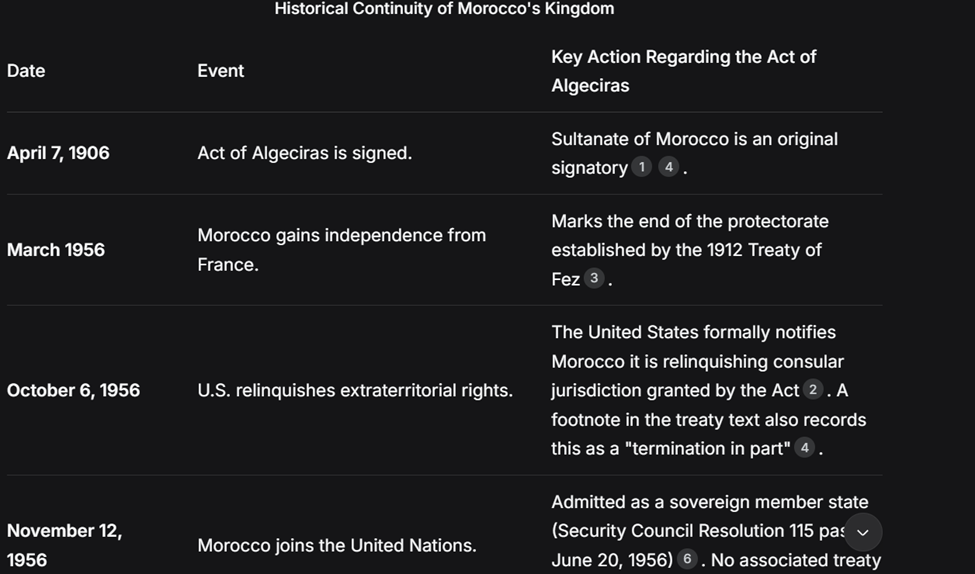
Instead of "re-accessing" the old treaty, the newly independent Kingdom of Morocco and other signatory states focused on **terminating its most significant provisions**, effectively dismantling the colonial-era framework. The key developments are summarized below:
| Date | Event | Key Action Regarding the Act of Algeciras | | :--- | :--- | :--- | | **April 7, 1906** | Act of Algeciras is signed. | Sultanate of Morocco is an original signatory. | | **March 1956** | Morocco gains independence from France. | Marks the end of the protectorate established by the 1912 Treaty of Fez. | | **October 6, 1956** | U.S. relinquishes extraterritorial rights. | The United States formally notifies Morocco it is relinquishing consular jurisdiction granted by the Act. A footnote in the treaty text also records this as a "termination in part". | | **November 12, 1956** | Morocco joins the United Nations. | Admitted as a sovereign member state (Security Council Resolution 115 passed June 20, 1956). No associated treaty deposit is noted. |